
 By Robert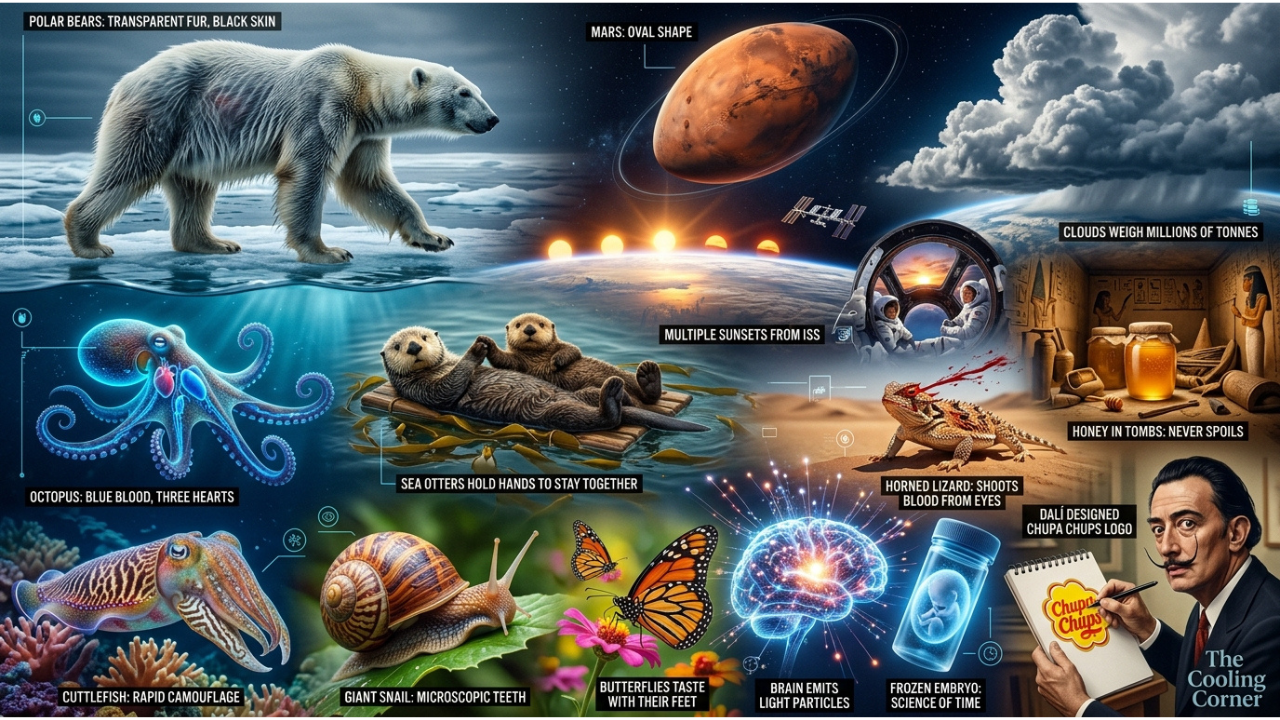
We all think we have a decent grip on reality. Then along comes a fact so bizarre, so utterly strange — yet completely verified by science — that it reshapes how you see the world.
That’s exactly what this list does.
We’ve collected 50 of the weirdest, most mind-bending facts across animals, the human body, space, history, and everyday life — all of them completely true. Buckle up, because some of these will seriously mess with your head.
Weird But True Animal Facts
Animals are stranger than any science fiction. Here’s proof.
1. Polar bears aren’t actually white
This one stops people cold (pun intended). Polar bears look white, but their fur is actually transparent and hollow. The hollow hairs trap sunlight and their skin underneath is jet black. The “white” appearance is just the way light reflects off the fur. Scientists believe the black skin helps absorb heat from sunlight — smart engineering by nature.
2. Octopuses have three hearts — and blue blood
An octopus has three hearts: two pump blood to the gills, and one pumps it to the rest of the body. But here’s the kicker — that blood is bright blue, not red. Why? Because octopus blood contains copper-based hemocyanin instead of iron-based hemoglobin. The copper turns blue when it binds with oxygen.
3. A snail has around 14,000 teeth
You read that right. Snails have a jaw-like organ called a radula, packed with thousands of microscopic teeth made of chitin. They use it to scrape algae and plant matter off surfaces. Bigger species can have even more. The world’s most toothy creature isn’t a shark — it’s the garden snail.
4. Butterflies taste with their feet
Butterflies have chemoreceptors on their feet — sensory organs that detect the chemical makeup of whatever they land on. The moment a butterfly lands on a leaf or flower, it instantly “tastes” it. This helps them identify which plants are safe to lay eggs on and which flowers contain nectar.
5. Sea otters hold hands while sleeping
One of the most heartwarming weird facts on this list: sea otters sleep floating on their backs on the ocean’s surface. To keep from drifting apart from their family members during sleep, they hold hands — or more precisely, wrap paws around each other. Scientists call this “rafting,” and yes, it’s exactly as adorable as it sounds.
6. Cuttlefish can change color in 200 milliseconds
Cuttlefish can shift their entire skin color and texture in under a fifth of a second — faster than a human blink. They do this for camouflage, communication, and mating displays. They can create rippling color waves across their bodies and mimic the texture of rocks, coral, and sand with stunning accuracy. They also have blue blood, like octopuses.
7. Tardigrades can survive in outer space — naked
Tardigrades (also called “water bears”) are microscopic animals measuring just 0.5mm. They can survive temperatures from near absolute zero (-273°C) to 150°C, pressures six times greater than the deepest ocean trench, radiation levels lethal to any other life form, and complete vacuum of outer space. The European Space Agency sent tardigrades into open space in 2007. They survived. They are, without question, the toughest animals on Earth.
8. The world’s shortest war lasted 38 minutes
Wait — that’s history, not animals. But it’s too good not to mention here: the Anglo-Zanzibar War of 1896 is officially the shortest war in recorded history. British forces bombarded the Sultan’s palace on August 27, 1896. The conflict was over in 38 minutes. Some arguments at dinner tables last longer.
9. Orcas have been seen wearing dead fish as hats
Scientists have actually observed orcas balancing dead fish — typically salmon — on their heads. No one fully understands why. Leading theories suggest it’s playful behavior, a form of social learning, or possibly a form of mourning-related activity. Whatever the reason, it confirms that orcas may be the quirkiest apex predators in the ocean.
10. Rats laugh when tickled — but at a frequency we can’t hear
When rats are tickled, they emit ultrasonic vocalizations at around 50 kHz — far above human hearing range. Researchers using specialized equipment confirmed these sounds are linked to positive emotions and social bonding. Rats even have specific brain regions for laughter similar to humans. So yes, rats giggle. You just can’t hear it.
Weird But True Facts About the Human Body
You’ve lived in your body your whole life. You still don’t know the half of it.
11. Your body has more bacterial cells than human cells
For decades, science textbooks said bacteria outnumber human cells 10 to 1. More recent research has revised that to roughly 1:1 — but the point stands: your body is as much bacterial as it is human. The majority live in your gut and play a critical role in digestion, immunity, and even mental health. You’re essentially a walking ecosystem.
12. You can’t taste food without saliva
Saliva is absolutely essential to flavor. Without it, food molecules can’t dissolve properly, which means your taste buds simply can’t detect them. Dry your tongue completely and taste something — you’ll experience little to nothing. Your entire experience of flavor depends on your mouth being wet.
13. When you read silently, your mouth still “speaks”
Even when reading in your head, the muscles of your mouth, tongue, and larynx subtly activate. Scientists call this “subvocalization.” Your brain is still essentially sounding out words even when you’re not moving your lips. It’s a leftover trait from when we first learned to read by speaking out loud.
14. Your enamel is the hardest substance in your body
Tooth enamel is harder than bone — it’s the hardest biological material your body produces. It’s strong enough to rival shark teeth in terms of biting force resistance. The catch? Unlike bone, enamel cannot regenerate. Once it’s gone, it’s gone for good. Which is why dentists keep reminding you to brush.
15. You travel 2.5 million km every single day — without moving
The Earth orbits the Sun at roughly 107,000 km/h. That means every single day, you travel about 2.5 million kilometres relative to the Sun, and about 19 million kilometres relative to the center of the Milky Way. You’re on a cosmic journey, whether you get out of bed or not.
16. Stomach acid is strong enough to dissolve metal
Human stomach acid has a pH of 1 to 2 — extremely acidic. A study published in the journal Gastrointestinal Endoscopy found that a razor blade’s “thickened back edge” dissolved after two hours in stomach acid. Your stomach lining replaces itself every few days specifically to survive its own acid. The human digestive system is genuinely terrifying.
17. Your brain emits light — but you can’t see it
In 2025, scientists at Scientific American reported that researchers detected biophotons — actual particles of light — emitted by the human brain, measuring them from outside the skull for the first time. The emission changed as people performed different mental tasks. What role, if any, these photons play in thinking remains unknown. Your brain literally glows.
18. Identical twins don’t have the same fingerprints
Even with identical DNA, no two people — not even identical twins — have the same fingerprints. This is because fingerprints are shaped not by genetics, but by random physical forces in the womb: the position of the fetus, the length of the umbilical cord, the rate of finger growth during development. Every fingerprint is uniquely shaped by circumstance.
19. Being bored is a “high arousal” state for your body
It might not feel like it, but physiologically, boredom is the opposite of relaxation. When you’re bored, your heart rate actually increases. Scientists classify boredom as a high-arousal state — your body is alert and seeking stimulation. That restless, uncomfortable feeling of boredom is your nervous system demanding something to engage with.
20. Newborn babies have high levels of an Alzheimer’s-linked protein
Newborn brains have surprisingly high levels of tau proteins — the same proteins whose abnormal buildup is linked to Alzheimer’s disease in adults. In healthy newborns, these levels are normal and decrease with age. Scientists think studying how this natural reduction occurs could hold clues to preventing or reversing Alzheimer’s. The same process that causes disease in the elderly is a normal feature of a baby’s developing brain.
Weird But True Space Facts
Space is under no obligation to make sense. And it definitely doesn’t.
21. A cloud weighs around one million tonnes
We look up at fluffy, light clouds floating effortlessly — but an average cumulus cloud weighs approximately one million tonnes (500,000 kg). They float because their density is slightly lower than the surrounding air, not because they’re light. If clouds fell as solid objects, they would be catastrophic.
22. Mars is shaped like a rugby ball, not a sphere
Unlike any other rocky planet in our solar system, Mars is not a true sphere. It’s technically shaped like a triaxial ellipsoid — a rugby ball with different measurements along all three axes. This irregular shape is thought to be the result of its geological history and rotational forces. So when someone says “round like a planet,” Mars is the awkward exception.
23. The Pacific Ocean is larger than all of Earth’s land combined
The Pacific Ocean spans more than 64 million square miles (165 million sq km). That’s bigger than the total combined land area of every continent on Earth. It’s so vast that if you removed all the land on the planet and placed it in the Pacific, there would still be ocean left over.
24. The Atlantic Ocean grows wider every year
Due to tectonic plate movement, the Atlantic Ocean expands by 2–4 centimeters per year. Meanwhile, the Pacific Ocean is slowly shrinking. In geological terms, the Atlantic is a young, growing ocean. This is the same process — seafloor spreading — that will eventually reshape the continents over millions of years.
25. There are more trees on Earth than stars in the Milky Way
The Milky Way contains an estimated 100–400 billion stars. Earth has approximately 3 trillion trees — that’s 3,000,000,000,000. So yes, there are more trees on our single planet than stars in our entire galaxy. Space feels less infinite when you look at it that way.
26. The first animals sent to space were fruit flies
In 1947 — before Laika the dog, before any human astronaut — scientists launched fruit flies aboard a captured Nazi V-2 rocket. They wanted to study the effects of cosmic radiation on living organisms. The flies reached an altitude of 108 km (space begins at 100 km) and were recovered alive. Tiny pioneers.
27. At the North Pole, every direction is south
At the geographic North Pole, all lines of longitude converge into a single point. This means no matter which way you face, you are facing south. There is no east, west, or north at the North Pole. For the same reason, the North Pole technically exists in every time zone simultaneously — so no official time zone is assigned to it.
Weird But True Historical Facts
History is full of moments so bizarre they sound like fiction.
28. In 1912, a man jumped off the Eiffel Tower in a flying suit — and died
Franz Reichelt, a French-Austrian tailor, invented a wearable parachute suit for pilots. After testing it on mannequins (which he believed proved its effectiveness), he decided to test it himself by jumping from the first platform of the Eiffel Tower. On February 4, 1912, in front of a crowd and cameras, he jumped. The suit failed entirely. The whole thing was captured on film, and the footage still exists.
29. Sliced bread was briefly banned in the United States
The first commercially sliced bread was sold in 1928. But in January 1943, the U.S. government banned it. The official reason: to conserve the wax paper and flour needed for the war effort. The public outcry was so intense that the ban was lifted just three months later. The phrase “the best thing since sliced bread” was apparently not ironic to people who had lived without it.
30. A chicken once lived for 18 months without its head
In 1945, a Colorado farmer named Lloyd Olsen beheaded a chicken named Mike — but the axe missed the jugular vein, and the brain stem remained mostly intact. Mike survived, and Olsen fed him a liquid diet through his exposed neck for 18 months. “Headless Mike” went on tour, became a national sensation, and is still celebrated annually in Fruita, Colorado.
31. Buzz Lightyear’s original name was “Lunar Larry”
Pixar’s beloved space ranger almost had a very different identity. During early development of Toy Story, the character now known as Buzz Lightyear was called “Lunar Larry.” The name Buzz was changed in honor of Apollo 11 astronaut Buzz Aldrin, giving the character a more heroic, space-exploration resonance. Lunar Larry just doesn’t have the same ring to it.
32. The Jurassic Park raptor sounds are actually tortoises mating
The famous “raptors barking at each other” in Jurassic Park was created by sound designer Gary Rydstrom using recordings of tortoises having sex. Rydstrom later admitted: “It’s somewhat embarrassing, but when the raptors bark at each other to communicate, it’s a tortoise having sex.” One of the most iconic sounds in cinematic history. You’re welcome.
Weird But True Nature & Science Facts
The natural world doesn’t follow the rules you think it does.
33. Strawberries are not berries. Bananas are.
Botanically speaking, a berry is a fruit that develops from a single ovary. By this definition: bananas, avocados, kiwis, and watermelons are all berries. Strawberries, raspberries, and blackberries? Not berries. They’re “aggregate fruits.” This is one of those facts that seems wrong, but the science is unambiguous.
34. Rhubarb grows so fast in spring you can actually hear it
Under the right conditions — particularly in “forcing sheds” where rhubarb is grown in near-total darkness — the plant grows so rapidly that it produces a faint creaking, popping sound as it expands. Multiple farmers and BBC journalists have documented this. It’s caused by the rapid cellular expansion of the plant’s stalks pushing against each other.
35. Honey never goes bad. Ever.
Archaeologists have found 3,000-year-old honey in Egyptian tombs that was still perfectly edible. Honey’s antibacterial properties come from its very low moisture content, acidic pH, and the presence of hydrogen peroxide. Bacteria simply can’t survive in it. As long as honey stays sealed and dry, it can last indefinitely. The oldest honey ever found was estimated to be over 5,500 years old.
36. Quicksand won’t actually swallow you alive
The Hollywood version of quicksand — slowly sinking until fully submerged — is scientifically impossible. Quicksand’s density is actually higher than the human body’s, meaning you physically cannot sink completely. You’d get stuck up to your waist or chest at most. The real danger of quicksand is getting stuck in a remote area, not drowning in it.
37. A horned lizard shoots blood from its eyes as a defense mechanism
The horned lizard (Phrynosoma) can shoot streams of blood from its eyes as a defense against predators. It does this by restricting blood flow from the head, increasing blood pressure in its ocular sinuses until they burst. The blood can travel up to 9 times the lizard’s body length. The blood also contains chemicals from its ant-heavy diet that are repulsive to canine predators specifically.
38. Chewing gum contains microplastics — and you swallow some
A 2024 UCLA study found that a single stick of chewing gum releases hundreds to thousands of microplastic particles during chewing — and yes, you swallow some of them. The main culprit is the synthetic gum base, which is made from petrochemical polymers. Scientists are still studying what, if any, health effects these microplastics may have on the human body.
39. Elephants are essential for guitar manufacturing
African ebony trees — which provide the wood for guitar fingerboards and piano keys — reproduce almost exclusively through elephants. Elephants eat the trees’ fruit, and the seeds travel intact through their digestive system before being deposited miles away in the animals’ dung. This was confirmed by UCLA researchers in 2025. Without elephants, the guitar as we know it may not exist.
40. A baby was born in 2025 from a 31-year-old embryo
Weird But True Everyday Facts
These are facts about things you encounter every day — and had no idea about.
41. The plastic tip of your shoelace has a name
It’s called an aglet. Its function is to keep the end of the lace from fraying and to make it easier to thread through the eyelets of a shoe. The word comes from the Old French “aguillette,” meaning “small needle.” Now you know.
42. Central Park is bigger than the entire country of Monaco
New York City’s Central Park covers 843 acres (3.41 sq km). Monaco — an entire sovereign nation on the French Riviera — is just 2.02 sq km. Central Park is bigger than a country. It also contains more trees than many small European towns.
43. Over 60% of the world’s lakes are in Canada
Canada has somewhere between 2 and 3 million lakes, depending on how you define a lake. This represents over 60% of the world’s freshwater lakes. Canada has more lake surface area than the rest of the planet combined. It’s a genuinely staggering geographical quirk.
44. The ISS orbits Earth every 90 minutes
The International Space Station travels at roughly 28,000 km/h, completing a full orbit of Earth once every 90 minutes. That means astronauts aboard the ISS witness 16 sunrises and 16 sunsets every single day. They have to manually set their clocks to maintain a normal 24-hour day.
45. Boredom makes you crave stimulation so strongly it can be physically painful
Research has shown that when left completely alone with their thoughts for 6–15 minutes, a significant percentage of people — particularly men — would rather administer a mild electric shock to themselves than sit quietly with nothing to do. In a 2014 University of Virginia study, 67% of men and 25% of women chose to shock themselves rather than simply be alone with their thoughts. The human mind cannot tolerate emptiness.
46. Birds don’t pee
Birds don’t have a urinary bladder or a separate exit for liquid waste. Instead, they combine solid waste and liquid waste into a single white-and-brown paste, expelled through one opening called the cloaca. This is an evolutionary adaptation — carrying the weight of a liquid-filled bladder would make flight more energy-intensive. The white part of bird droppings is actually the equivalent of urine.
47. Salvador Dalí designed the Chupa Chups logo
In 1969, the Spanish lollipop company Chupa Chups asked surrealist artist Salvador Dalí to redesign their logo. He reportedly completed the design in under an hour and suggested placing it on top of the lollipop wrapper rather than the side, so it would always be visible. The logo has barely changed since.One of the most famous artists in history designed one of the world’s most recognized candy brands — almost as a throwaway project.
48. Rhode Island is smaller than Los Angeles County
The entire state of Rhode Island — a full U.S. state with its own government, senators, and representatives — covers 4,001 square km. Los Angeles County alone covers 10,517 square km. One county in California is more than twice the size of an entire U.S. state. And yet Rhode Island has been a state since 1790.
49. The human nose can detect over 1 trillion distinct smells
For a long time, science textbooks said humans could smell about 10,000 different odors. A 2014 study from Rockefeller University revised that estimate dramatically upward — to at least 1 trillion distinct smells. The human olfactory system is far more sophisticated than anyone previously believed, making smell potentially our most complex and underappreciated sense.
50. You’re reading this because your brain invented language to talk to itself
Language gave humans the ability to think in abstract concepts, plan for the future, and build mental models of the world. Every word you’ve read on this page is your brain talking to itself.
Final Thoughts: The World Is Stranger Than You Think
Reality doesn’t owe us a story that makes immediate sense. From tardigrades surviving outer space to clouds that weigh a million tonnes, from rats that laugh to honey that survives 3,000 years — the universe is relentlessly, magnificently weird.
And that’s exactly what makes it worth paying attention to.
Every one of these 50 facts is fully verified and scientifically documented. None of them are myths or exaggerations. The world is strange enough without making anything up.
Enjoyed this? Share it with someone who loves weird facts — and check out more cool, surprising content every week on The Cooling Corner, your go-to corner for cool ideas and trending topics.